
Cybercrime or Hybrid Warfare? The Unanswered Questions Behind Europe's Supermarket Attacks

Cyberattacks on supermarket refrigeration systems across Europe have spoiled food and caused substantial losses, with some units reportedly reaching 50°C. No perpetrators or clear motives have been identified, and investigators have not established whether the incidents are connected. The attacks expose weaknesses in digitally connected food infrastructure and raise urgent questions about cybersecurity across the supply chain.
Supermarket freezers across Europe have been hacked, destroying vast quantities of food and leaving retailers counting their losses. Nobody has claimed responsibility, no clear financial motive has emerged, and investigators are still trying to establish whether the attacks are connected. So who is behind them, and what exactly are they trying to achieve?
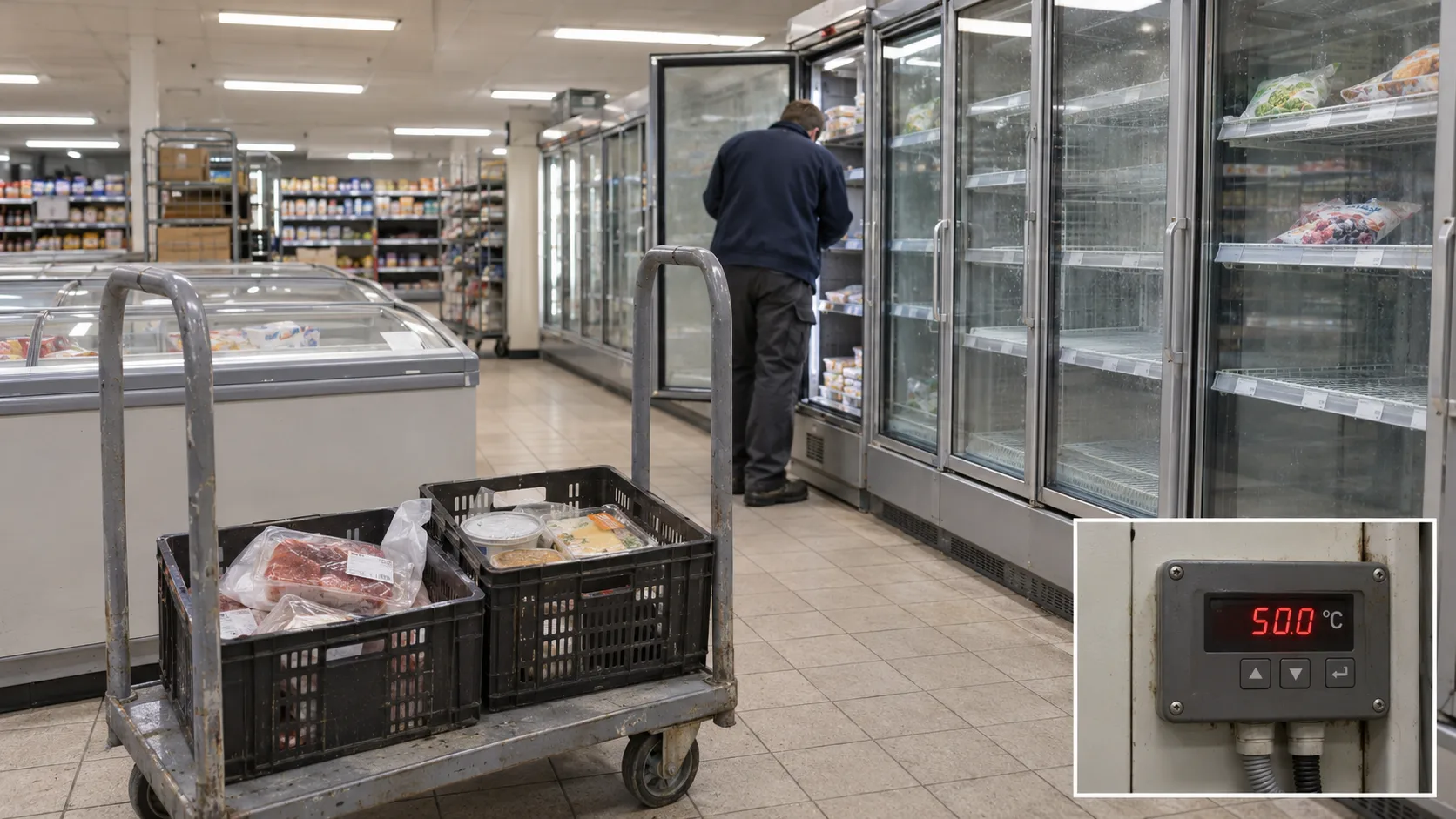
At two o'clock on Monday morning, somebody was turning supermarket freezers across Europe into ovens. No armed intruders, no explosives, not even a broken window. Just a few commands issued remotely, and by breakfast, perfectly edible food was being wheeled out in shopping carts destined for the trash.
From Sweden to Belgium, Ireland to Estonia, supermarkets discovered that their refrigeration systems had been manipulated overnight, with temperatures in some units reaching an extraordinary 122°F (50°C). Meat, dairy products, and frozen goods were rendered unsellable. At one ICA supermarket in Stockholm, sales manager Engla Ingwall's assessment was painfully succinct: "Everything is destroyed."
The incidents affected major retailers including ICA, Coop, Carrefour, Delhaize, and SuperValu, as well as an IKEA store in Belgium. Around 40 Delhaize supermarkets in Belgium and Luxembourg reported disruptions, alongside 13 SuperValu stores in Ireland and 15 Carrefour outlets in Belgium. One Belgian supermarket reportedly lost €100,000 worth of produce.
And this was not Europe's first encounter with weaponized refrigeration. In October, hackers targeted hundreds of French supermarkets, causing fires and food losses running into millions of euros.
Two waves of attacks in less than a month, with no confirmed perpetrators.
Who is going to the trouble of hacking supermarket refrigerators, and perhaps more importantly, why?
Sabotage, or Something Worse?
Modern supermarkets rely on interconnected digital systems that allow refrigeration equipment to be monitored and adjusted remotely. It is efficient, convenient, and, as recent events demonstrate, a potentially spectacular security liability.
According to Belgian refrigeration operator Sabcobel, attackers switched evaporators into defrost mode, sending temperatures soaring. Some affected equipment used controllers supplied by Danish manufacturer Danfoss, which has said it previously identified vulnerabilities and advised customers to install updates.
The technical explanation is relatively straightforward. The motive is anything but.
Cybercriminals generally want something in return, whether money, sensitive information, or leverage over their victims. Yet no ransom demands have been publicly reported in these incidents, raising the possibility that the destruction itself was the objective.
Tom Hegel, a researcher at cybersecurity firm SentinelOne, told Reuters that the absence of financial demands could point toward sabotage rather than conventional ransomware. He also highlighted how difficult such attacks can be to attribute, warning that "A teenager and an intelligence service would look much the same from the defender's side."
Which is hardly reassuring.
European authorities have repeatedly warned about hybrid warfare and attacks against civilian infrastructure, particularly amid heightened tensions following Russia's invasion of Ukraine. Disrupting food supplies could, in theory, offer hostile actors a way to inflict economic damage and undermine public confidence without deploying a single soldier.
The European Union's agriculture commissioner, Christophe Hansen, described the incidents as "a deliberate attempt to disrupt our food supply chain and undermine consumers' confidence in it."
But there is an important distinction between recognizing sabotage and identifying a saboteur. Investigators have not established who carried out the attacks, whether the incidents were coordinated, or whether any government was involved. There is no publicly confirmed evidence linking Russia to them.
Could this be a politically motivated attempt to destabilize European economies? An experiment to discover how vulnerable essential infrastructure really is? Or simply opportunistic hackers who found an open door and decided to see how much damage they could cause?
For now, nobody knows.
Europe's Expensive Illusion of Security
The consequences are already painfully real for the businesses involved. Belgian butcher Luc De Laet told Reuters that an employee woke him at 3:30 a.m. after refrigeration temperatures began rising at his store near Antwerp. He estimated that €15,000 worth of meat had been ruined.
"It's very scary," he said, describing how attackers could manipulate temperatures from a distance.
De Laet believes the objective was to destabilize European economies, although that remains his interpretation rather than an established finding. His frustration, however, is understandable. Imagine spending years building a business, only to watch thousands of euros' worth of stock become worthless because somebody, somewhere, decided to tamper with a computer.
There is something almost ridiculous about such a sophisticated form of sabotage being directed at supermarket freezers. The economic consequences are considerably less amusing.
For years, European governments have enthusiastically promoted digitalization as the future of economic competitiveness. Refrigerators, warehouses, transportation networks, and industrial equipment are increasingly connected to the internet, promising greater efficiency and lower costs.
Yet technological sophistication is not the same thing as security.
A supermarket can have reliable suppliers, functioning delivery networks, and fully stocked warehouses, only to lose its produce because somebody gains access to a temperature controller. Farmers produce the food, truck drivers transport it, retailers absorb the immediate losses, and consumers ultimately pay for the inefficiencies of an increasingly vulnerable system.
Britain's 2024 Food Security Report warned that cyberattacks could affect virtually every stage of the food supply chain. The UK has not reported being affected by Monday's incidents, but its National Cyber Security Centre is working with industry and international partners to assess the threat.
If vulnerabilities were already apparent after the French attacks, why were similar systems still exposed weeks later? And if hackers can manipulate refrigeration equipment across several countries overnight, what else might they be able to access?
These are questions governments should have been asking long before supermarket freezers started reaching 122°F (50°C).
The Real Cost of Digital Dependence
None of this means Europe's food supply is on the verge of collapse. The latest incidents affected a relatively small proportion of the continent's supermarkets, and several retailers contained the disruption without significant consequences for their wider distribution networks.
But the absence of a catastrophe is hardly proof of adequate security.
The real concern is how easily ordinary commercial equipment can become a tool for economic disruption. Warehouses, food-processing facilities, and agricultural systems increasingly depend on connected technology, and vulnerabilities in those networks could prove considerably more damaging than a few emptied supermarket aisles.
Governments should be demanding stronger safeguards, while manufacturers and retailers must stop treating cybersecurity as an optional upgrade. Known vulnerabilities are not merely technical inconveniences when exploiting them can destroy essential goods.
Yet the biggest question remains unanswered. Nobody has claimed responsibility, investigators have not identified a clear motive, and the similarities between the French attacks and Monday's incidents have not established that the same perpetrators were involved.
Perhaps somebody wanted to send Europe a political message. Perhaps they were testing its defenses. Or perhaps the attackers simply discovered that causing substantial economic damage was far easier than anyone had imagined.
Whatever the explanation, the result is an uncomfortable demonstration of how much damage can be inflicted without a weapon, a border crossing, or even a physical presence.
A continent that cannot protect its food supply from a keyboard has some uncomfortable questions to answer about its security.